
Code K limit: never fly the Code K above 12 kt apparent wind. Reef early — reef the main first, then change headsails.
Warning: Updated limit: the Code K maximum is now 12 kt apparent wind. The chart below still shows the older 15 kt limit — follow 12 kt.
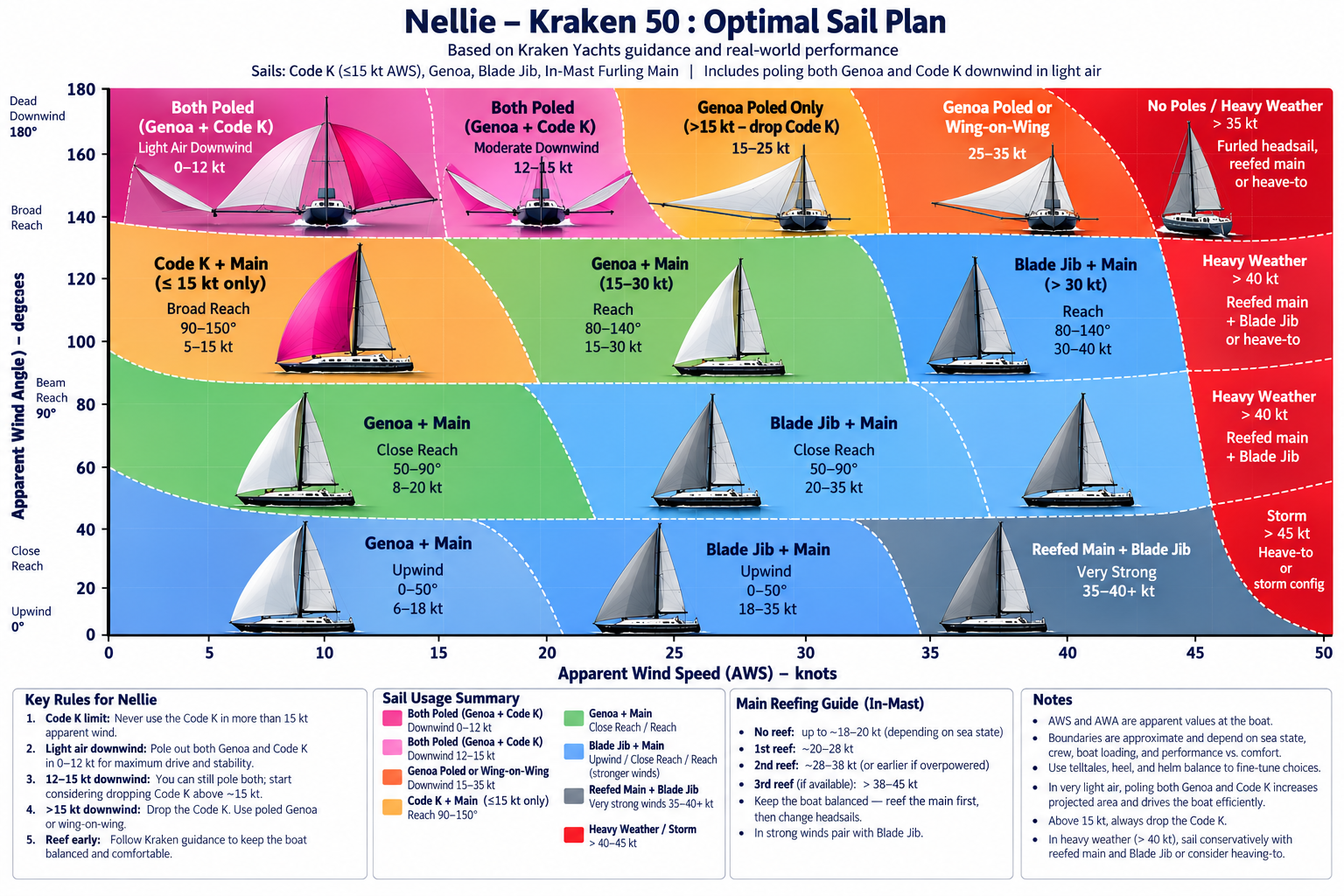
Quick reference — apparent wind
| Point of sail | AWA | Light | Moderate | Strong |
|---|---|---|---|---|
| Upwind | 0–50° | Genoa + Main (6–18 kt) | Blade Jib + Main (18–35 kt) | Reefed Main + Blade Jib (35–40+ kt) |
| Close reach | 50–90° | Genoa + Main (8–20 kt) | Blade Jib + Main (20–35 kt) | Reefed Main + Blade Jib (> 40 kt) |
| Reach | 80–140° | Genoa + Main (15–30 kt) | Blade Jib + Main (30–40 kt) | Reefed Main + Blade Jib or heave-to (> 40 kt) |
| Broad reach | 90–150° | Code K + Main (5–12 kt) | Genoa + Main (12–30 kt) | Blade Jib + Main (> 30 kt) |
| Downwind | 140–180° | Both poled — Genoa + Code K (0–12 kt) | Genoa poled only (12–25 kt) | Genoa poled or wing-on-wing (25–35 kt); no poles above 35 kt |
Key rules for Nellie
- Code K limit — never use the Code K in more than 12 kt apparent wind.
- Light air downwind — pole out both Genoa and Code K in 0–12 kt for maximum drive and stability.
- Approaching 12 kt — get ready to drop the Code K before the wind builds past the limit.
- Above 12 kt downwind — drop the Code K. Use the poled Genoa or wing-on-wing.
- Reef early — follow Kraken guidance to keep the boat balanced and comfortable.
Main reefing guide (in-mast furling)
| Reef | Apparent wind |
|---|---|
| No reef | Up to ~13–15 kt (depending on sea state) |
| 1st reef | ~15–23 kt |
| 2nd reef | ~23–33 kt (or earlier if overpowered) |
| 3rd reef | > 33–40 kt |
- Keep the boat balanced — reef the main first, then change headsails
- In strong winds, pair the reefed main with the Blade Jib
Heavy weather
- Above 35 kt downwind — no poles: furled headsail, reefed main, or heave-to
- Above 40 kt — sail conservatively with reefed main and Blade Jib, or heave-to
- Above 45 kt — storm configuration or heave-to
Notes
- AWS and AWA are apparent values at the boat
- Boundaries are approximate — they depend on sea state, crew, boat loading, and performance vs. comfort
- Use telltales, heel, and helm balance to fine-tune choices